
Capuchin Monkeys vs. Spider Monkeys Comparison
Unravel the fascinating differences between these two iconic New World monkeys, from their physical prowess to their cognitive abilities.
Explore Primate InsightsKey Takeaways
- ✓ Capuchin monkeys are known for their intelligence and tool use.
- ✓ Spider monkeys are highly arboreal, famous for their prehensile tails.
- ✓ Both species are New World monkeys, but inhabit different ecological niches.
- ✓ Capuchins are generally smaller and more robust, while spider monkeys are larger and more slender.
How It Works
We'll begin by detailing the distinct physical characteristics that set Capuchin and Spider monkeys apart, such as size, fur, and tail usage. This foundational knowledge helps in recognizing each species in their natural habitats.
Next, we delve into their unique behaviors, including social structures, foraging strategies, and communication methods. These insights reveal how each species navigates its environment and interacts with its group.
The comparison then shifts to their renowned intelligence, examining tool use in Capuchins and the complex spatial memory of Spider monkeys. This section highlights their problem-solving skills and adaptability.
Finally, we'll explore their respective roles within their ecosystems, from seed dispersal to predator-prey dynamics. Understanding their ecological contributions emphasizes their importance to biodiversity.
Physical Disparity: Size, Structure, and Specialized Adaptations
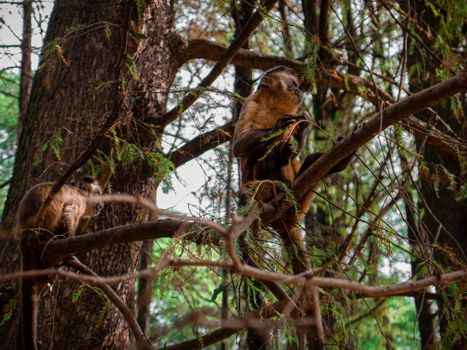 Photo: Bruno Bordini / Pexels
Behavioral Contrasts: Social Structures, Foraging, and Communication
You may also find monkey-app.net useful.
Cognitive Capabilities: Intelligence and Problem-Solving Strategies
Ecological Roles and Conservation Status: Threats and Importance
Comparison
| Feature | Capuchin Monkey | Spider Monkey |
|---|---|---|
| Average Size | Smaller (3-9 lbs, 12-22 in body) | Larger (13-24 lbs, 16-25 in body) |
| Tail Type | Semi-prehensile (for balance) | Highly Prehensile (fifth limb) |
| Diet | Omnivorous (fruits, insects, small vertebrates) | Frugivorous (primarily ripe fruit) |
| Social Structure | Large, stable multi-male/female groups | Fission-fusion communities |
| Primary Intelligence | Tool use, problem-solving, dexterity | Spatial memory, navigation, social cognition |
| Arboreal/Terrestrial | Both (more robust build) | Highly Arboreal (slender, long limbs) |
| Conservation Status | Varies (some Critically Endangered) | All species Vulnerable to Critically Endangered |
What Readers Say
"This Capuchin monkeys vs spider monkeys comparison is incredibly insightful. It perfectly articulates how their physical differences directly influence their unique behavioral strategies and cognitive strengths. A must-read for primatology enthusiasts!"
Dr. Eleanor Vance · Miami, FL"I always thought monkeys were all the same, but this article truly opened my eyes. The detailed breakdown of their intelligence and ecological roles made me appreciate the complexity of each species. Great content!"
Mark Jenkins · Austin, TX"As a wildlife documentarian, I found this comparison invaluable. The analysis of their social structures and foraging techniques provided new perspectives that will definitely enhance my next project on New World primates."
Sarah Chen · Seattle, WA"While incredibly comprehensive, I would have loved to see a small section on their vocalizations or specific alarm calls. Still, an excellent resource that beautifully explains the Capuchin monkeys vs spider monkeys comparison."
David Rodriguez · Denver, CO"Understanding the conservation status differences was particularly impactful. It's not just about their cuteness; it's about their vital role in our ecosystems. This article makes that perfectly clear."
Jessica Lee · Chicago, ILFrequently Asked Questions
What are the primary physical differences between Capuchin and spider monkeys?
Capuchin monkeys are generally smaller, more robust, and have a semi-prehensile tail used for balance. Spider monkeys are larger, more slender, and possess a highly prehensile tail that acts as a fifth limb, crucial for their arboreal lifestyle. Their limb structure also differs, with spider monkeys having longer, more slender limbs and reduced thumbs for efficient brachiation.
Are Capuchin monkeys or spider monkeys more intelligent?
Both species exhibit high levels of intelligence, but in different ways. Capuchin monkeys are renowned for their instrumental tool use and problem-solving dexterity. Spider monkeys, on the other hand, show exceptional spatial memory, navigation skills, and complex social cognition vital for their fission-fusion societies and fruit-finding strategies. It's a difference in the manifestation of their cognitive strengths rather than one being universally 'smarter'.
How do their diets differ, and what ecological roles do they play?
Capuchin monkeys are omnivorous, consuming a wide variety of fruits, insects, small vertebrates, and nuts. They act as seed dispersers and pest controllers. Spider monkeys are predominantly frugivorous, relying heavily on ripe fruits. They are considered keystone species due to their critical role as long-distance seed dispersers, essential for forest regeneration and biodiversity.
Why are spider monkeys more endangered than Capuchin monkeys?
All spider monkey species are classified as vulnerable to critically endangered due to their specialized diet, large home ranges, and slower reproductive rates, making them highly susceptible to habitat loss, fragmentation, and hunting pressure. While some Capuchin species are also endangered, their broader diet and adaptability have historically made them more resilient, though they too face significant threats.
Can Capuchin and spider monkeys coexist in the same habitat?
Yes, Capuchin and spider monkeys can and often do coexist in the same rainforest habitats. Their differing foraging strategies, social structures, and preferred canopy levels minimize direct competition for resources, allowing them to occupy distinct ecological niches within the same ecosystem.
Who would benefit most from understanding this comparison?
Anyone interested in primatology, wildlife conservation, ecological studies, or simply curious about the incredible diversity of life in rainforests would benefit from this comparison. It provides a deeper understanding of evolutionary adaptation, primate behavior, and the critical importance of these species to their ecosystems.
What are the main threats to both Capuchin and spider monkey populations?
The primary threats to both species are habitat loss and fragmentation due to deforestation for agriculture, logging, and cattle ranching. The illegal pet trade and hunting for bushmeat also pose significant dangers to their populations, particularly for the more vulnerable spider monkeys.
What future trends might impact these primate species?
Future trends include the escalating impact of climate change on rainforest ecosystems, potentially altering fruit availability and habitat suitability. Continued human encroachment and resource extraction will also intensify pressure. Conversely, advancements in conservation technology and increased global awareness offer hope for more effective protection strategies.
Delve deeper into the fascinating world of New World primates by exploring more comprehensive comparisons. Understanding the intricate differences between species like Capuchin and spider monkeys is crucial for effective conservation and appreciating the planet's rich biodiversity. Continue your journey of discovery and support efforts to protect these intelligent and vital creatures.