✓ The Samsung Galaxy S24 features advanced AI capabilities with Galaxy AI.
✓ The iPhone 15 introduces the Dynamic Island and USB-C connectivity.
✓ Both devices offer exceptional camera systems, but with different processing philosophies.
✓ Battery life varies significantly based on usage patterns and specific models (Plus/Pro).
✓ Performance is top-tier on both, powered by custom-designed chipsets.
How It Works
1
Understand Your Priorities
Before diving into specs, identify what matters most to you: camera, battery life, operating system, or specific features. This will guide your comparison.
2
Evaluate Core Specifications
Examine processor, RAM, storage, and display technologies. These fundamental components dictate the overall performance and user experience of each phone.
3
Deep Dive into Key Features
Beyond specs, explore unique selling points like AI features on the S24 or the Dynamic Island on the iPhone 15. Consider how these innovations align with your daily usage.
4
Consider Ecosystem and Longevity
Think about your current tech ecosystem (Apple vs. Android) and the expected software support lifespan. This impacts future compatibility and device value.
Performance and Processing Power: A Head-to-Head Battle
Photo: Jakub Pabis / Pexels
When you compare Samsung Galaxy S24 vs iPhone 15, one of the most critical aspects to scrutinize is the raw processing power and overall performance. At the heart of the Samsung Galaxy S24 series, particularly in the US market, lies Qualcomm's latest and greatest, the Snapdragon 8 Gen 3 for Galaxy. This custom-tuned chipset boasts significant improvements in CPU, GPU, and NPU (Neural Processing Unit) performance compared to its predecessor. Samsung has historically worked closely with Qualcomm to optimize these chips, resulting in a powerhouse designed to handle everything from demanding gaming sessions to complex AI tasks with remarkable efficiency. The Snapdragon 8 Gen 3 for Galaxy is engineered for sustained performance, meaning it can maintain high clock speeds for longer periods without significant thermal throttling, which is crucial for heavy users and those engaging in intensive applications. This translates to incredibly fluid multitasking, instantaneous app launches, and seamless navigation through even the most graphically intensive mobile games. Furthermore, the enhanced NPU is a cornerstone of the S24's new 'Galaxy AI' features, enabling on-device processing for functionalities like live translation, advanced photo editing suggestions, and intelligent search capabilities, all without relying solely on cloud services.
On the other side of the ring, the iPhone 15 (and 15 Plus) is powered by Apple's A16 Bionic chip. While this isn't Apple's absolute newest silicon (the iPhone 15 Pro models feature the A17 Pro), it's still an incredibly potent and highly optimized processor that debuted in the iPhone 14 Pro series. The A16 Bionic is renowned for its exceptional single-core and multi-core performance, often outperforming many Android flagships in synthetic benchmarks. Apple's integrated hardware and software approach allows for unparalleled optimization, ensuring that iOS runs with buttery smoothness and applications are incredibly responsive. The A16 Bionic also features a powerful Neural Engine, which handles machine learning tasks efficiently, supporting features like Cinematic Mode, advanced photographic computational techniques, and Siri's capabilities. While perhaps not as overtly AI-centric as the S24's dedicated 'Galaxy AI' marketing, the iPhone 15 leverages its Neural Engine for a vast array of intelligent features that seamlessly integrate into the user experience. For everyday tasks, both phones are undeniably fast and capable. The choice often comes down to personal preference for Android's customizability versus iOS's streamlined simplicity and long-term software support. While benchmarks might show slight leads for one over the other in specific scenarios, in real-world usage, both devices offer a premium, lag-free experience that will satisfy even the most demanding users. The true differentiator might be the specific AI features that the S24 brings to the table, which are more explicitly highlighted and integrated into its user interface, potentially offering a more 'futuristic' feel for those interested in cutting-edge intelligent functionalities. For a deeper look into mobile chipsets, explore this guide to smartphone processors.
Camera Capabilities: Capturing Your World in Detail
Photo: Phong Thanh / Pexels
The camera system is often a make-or-break feature for many smartphone buyers, and when you compare Samsung Galaxy S24 vs iPhone 15, you're looking at two of the best in the business, albeit with distinct approaches to image processing and feature sets. The Samsung Galaxy S24 continues Samsung's tradition of offering versatile camera setups. While the core hardware might seem familiar to its predecessor, Samsung has focused heavily on computational photography enhancements and the integration of AI. The S24 typically features a triple-lens rear camera system: a high-resolution main sensor (often around 50MP), an ultrawide lens, and a telephoto lens (often 3x optical zoom). This configuration provides excellent flexibility for various shooting scenarios, from expansive landscapes to detailed close-ups. Samsung's image processing tends to produce vibrant, punchy colors, often boosting saturation and contrast to create a visually striking image right out of the camera. Low-light performance has seen significant improvements, with enhanced night mode algorithms that leverage the powerful Snapdragon 8 Gen 3 for Galaxy to capture more detail and reduce noise in challenging conditions. The new 'Galaxy AI' features also extend to the camera, offering advanced editing tools like Generative Edit, which allows users to resize or reposition subjects and fill in backgrounds, as well as AI-powered suggestions for optimal shots. Video recording is robust, supporting high resolutions and frame rates, with improved stabilization and various creative modes.
Conversely, the iPhone 15 features a dual-camera system on the back, comprising a significantly upgraded 48MP main sensor and a 12MP ultrawide lens. Apple's decision to bring the 48MP sensor from the Pro models to the standard iPhone 15 is a substantial upgrade, allowing for much more detail, especially when shooting in good light, and enabling 2x optical quality zoom by cropping into the high-resolution sensor. Apple's philosophy revolves around delivering natural, true-to-life colors and excellent dynamic range. Their computational photography, driven by the A16 Bionic's Neural Engine, excels at Smart HDR and Deep Fusion, which combine multiple exposures to produce a balanced and detailed image. Portrait mode has seen improvements, offering more control over depth of field after the fact. Video recording on the iPhone is often considered industry-leading for its smooth stabilization, accurate color science, and cinematic quality, with features like Cinematic Mode for professional-looking depth effects. While the iPhone 15 lacks a dedicated telephoto lens, its 2x 'optical quality' zoom is surprisingly effective for most users. The key difference often lies in the aesthetic: Samsung aims for a more dramatic, 'ready-to-share' look, while Apple prioritives a natural, accurate rendition that allows for more post-processing flexibility. Both are exceptional, but your preference for color science and AI-driven editing tools might sway your decision. The S24's explicit AI editing features might appeal to those who enjoy tinkering with their photos directly on the device, while the iPhone 15 offers a more 'point-and-shoot' excellence with subtle, powerful computational enhancements.
Display and Design: Aesthetics Meet Functionality
Photo: Andrey Matveev / Pexels
The display and design aspects are where the tactile experience of a smartphone truly comes to life, and both the Samsung Galaxy S24 and iPhone 15 offer premium aesthetics and vibrant screens. When you compare Samsung Galaxy S24 vs iPhone 15, you're looking at different design philosophies that cater to distinct user preferences. The Samsung Galaxy S24 typically features a Dynamic AMOLED 2X display, known for its incredibly vibrant colors, deep blacks, and excellent contrast. Samsung's displays are often praised for their brightness, which has been further enhanced in the S24 series, reaching impressive peak brightness levels for superior outdoor visibility. The S24 also boasts an adaptive refresh rate, often ranging from 1Hz to 120Hz, ensuring buttery-smooth scrolling and animations while conserving battery life when static content is displayed. The design of the S24 is usually characterized by its sleek, modern aesthetic, often with flatter edges than previous generations, providing a comfortable grip. Samsung utilizes premium materials, typically an Armor Aluminum frame and Gorilla Glass Victus 2 (or newer) on both the front and back, offering robust durability. The bezels are incredibly thin, maximizing the screen-to-body ratio and providing an immersive viewing experience. Samsung's commitment to innovation is also seen in its continued refinement of the punch-hole camera design, which is minimally intrusive.
On the other hand, the iPhone 15 features Apple's Super Retina XDR display, an OLED panel that delivers exceptional color accuracy, high contrast, and impressive brightness. While the standard iPhone 15 doesn't offer a 120Hz ProMotion display (that's reserved for the Pro models), its 60Hz refresh rate is still very fluid thanks to iOS optimization. A significant design change for the iPhone 15 is the introduction of the Dynamic Island, which replaces the traditional notch. This innovative pill-shaped cutout dynamically expands and contracts to display alerts, notifications, and ongoing background activities, transforming a hardware cutout into a functional and interactive software element. This adds a unique user interface experience that is exclusive to recent iPhone models. The iPhone 15 also features a new contoured edge design and a color-infused glass back, which offers a matte finish that is both aesthetically pleasing and more resistant to fingerprints than glossy surfaces. The frame is typically made of aerospace-grade aluminum, and the front features Apple's Ceramic Shield, which they claim is tougher than any smartphone glass. A major change across the iPhone 15 lineup is the switch from Lightning to USB-C, aligning with industry standards and offering greater compatibility with other devices. This not only simplifies charging but also enables faster data transfer speeds. Ultimately, both devices offer stunning displays and premium builds, but the S24 provides a higher refresh rate for smoother visuals, while the iPhone 15 introduces the unique Dynamic Island and the universal convenience of USB-C. For those heavily invested in the Apple ecosystem, the iPhone 15's design and features will feel familiar and refined, while the S24 offers a vibrant Android experience with cutting-edge display technology. Learn more about display technologies in this overview of OLED screens.
Battery Life, Software Experience, and Ecosystem Considerations
Beyond the core hardware, the daily user experience hinges significantly on battery life, the underlying software, and the broader ecosystem each device operates within. When you compare Samsung Galaxy S24 vs iPhone 15, these aspects often become the true deciding factors for many consumers. Battery life can be notoriously difficult to compare directly due to variations in usage patterns, network conditions, and software optimization. However, both the Samsung Galaxy S24 and iPhone 15 offer respectable all-day battery performance for most average users. The S24, often equipped with a slightly larger battery capacity than its predecessor and benefiting from the power efficiency of the Snapdragon 8 Gen 3 for Galaxy and its adaptive refresh rate display, aims to provide robust endurance. Samsung also offers fast charging capabilities, often supporting higher wattage charging than iPhones, allowing for quicker top-ups. Wireless charging and reverse wireless charging (Wireless PowerShare) are standard features on the S24, adding to its versatility. The iPhone 15, despite sometimes having a nominally smaller battery capacity, benefits immensely from Apple's meticulous hardware-software integration. The A16 Bionic chip is incredibly power-efficient, and iOS is designed to manage background processes and resource allocation with extreme precision, often leading to impressive real-world battery longevity. The iPhone 15 also supports fast charging, albeit typically at lower wattages than Samsung, and MagSafe wireless charging, which offers convenient magnetic alignment for accessories and faster wireless charging speeds than standard Qi. For specific battery life metrics, it's always best to consult independent, real-world tests as advertised numbers can be misleading.
The software experience is perhaps the most fundamental divergence between these two phones: Android 14 with Samsung's One UI 6.1 on the S24, and iOS 17 on the iPhone 15. One UI offers a highly customizable Android experience, with extensive options for personalization, multi-window multitasking, and a feature-rich ecosystem of Samsung-specific apps and services. The integration of 'Galaxy AI' brings new functionalities like Circle to Search, Chat Assist for tone adjustments, and Live Translate for real-time communication, aiming to make the S24 a more intelligent and proactive companion. Samsung is also committed to providing several years of major Android updates and security patches, enhancing the device's longevity. iOS 17, on the other hand, prioritizes simplicity, intuitiveness, and a cohesive user experience across all Apple devices. It's known for its strong privacy features, robust security, and seamless integration with Apple's services like iMessage, FaceTime, and iCloud. While less customizable than Android, iOS offers a polished and consistent interface that many users find incredibly easy to use. Apple is also unparalleled in its long-term software support, often providing major iOS updates for 5-7 years or even longer for its devices. The choice between Android and iOS is deeply personal, often stemming from prior experience or a preference for customization versus simplicity. For those already entrenched in an ecosystem, switching can be a significant hurdle due to app purchases, data migration, and adapting to a new interface. The S24 offers unparalleled flexibility and cutting-edge AI, while the iPhone 15 provides a streamlined, secure, and deeply integrated experience within the Apple universe. It boils down to whether you value an open, customizable platform with new AI frontiers or a highly optimized, user-friendly, and long-supported walled garden.
Comparison
Feature
Samsung Galaxy S24 (Base)
iPhone 15 (Base)
Winner/Edge
Processor
Snapdragon 8 Gen 3 for Galaxy
A16 Bionic
Slight edge to S24 for AI/raw Android power, iPhone for optimized efficiency
Display
Dynamic AMOLED 2X, 1-120Hz
Super Retina XDR, 60Hz
S24 (for 120Hz refresh rate)
Main Camera
50MP Wide, 12MP Ultra-wide, 10MP 3x Telephoto
48MP Wide, 12MP Ultra-wide
S24 (for dedicated telephoto)
Front Camera
12MP
12MP
Tie
Battery Life
Good, fast charging
Excellent, MagSafe charging
iPhone 15 (due to optimization)
Operating System
Android 14 (One UI 6.1)
iOS 17
User Preference
Unique Features
Galaxy AI, DeX, S Pen support (Ultra)
Dynamic Island, USB-C, MagSafe
Tie (distinct benefits)
Build Materials
Armor Aluminum, Gorilla Glass Victus 2
Aerospace-grade Aluminum, Ceramic Shield
Tie (both premium)
Software Updates
7 years (major OS + security)
5-7+ years (major OS + security)
S24 (explicit commitment)
What Our Readers Say
5★★★★★
"I was torn trying to compare Samsung Galaxy S24 vs iPhone 15, but the S24's AI features completely won me over. Live Translate is a game-changer for my international calls, and the camera's generative editing is surprisingly good."
Alex K.Seattle, WA
5★★★★★
"Upgrading to the iPhone 15 from an older Android was seamless. I love the Dynamic Island, and the camera takes consistently stunning photos without any fuss. The switch to USB-C was also long overdue and very welcome."
Maria G.Austin, TX
5★★★★★
"My decision to compare Samsung Galaxy S24 vs iPhone 15 came down to ecosystem. I'm deep in Apple's world, and the iPhone 15 just integrates perfectly with my MacBook and Apple Watch. Battery life is also noticeably better than my old phone."
Ben L.Chicago, IL
4★★★★☆
"The S24's display is incredible, and the 120Hz refresh rate makes everything feel so smooth. While the AI features are cool, I don't use them daily, and sometimes the camera can over-process images for my taste, but it's still a fantastic phone."
Chloe P.Denver, CO
5★★★★★
"As a photographer, the camera was paramount. I chose the S24 after I compare Samsung Galaxy S24 vs iPhone 15 because the dedicated telephoto lens and the versatility of Samsung's pro mode gave me more creative control, even with the iPhone's great main sensor."
David R.Miami, FL
Frequently Asked Questions
What are the biggest differences when I compare Samsung Galaxy S24 vs iPhone 15?
The biggest differences lie in their operating systems (Android vs. iOS), design philosophies (S24's high refresh rate screen and advanced AI vs. iPhone 15's Dynamic Island and USB-C), and camera processing. Samsung often offers more customization and explicit AI features, while Apple focuses on seamless integration and consistent performance within its ecosystem.
Is the Samsung Galaxy S24's camera better than the iPhone 15's?
It depends on your preference. The S24 often includes a dedicated telephoto lens and produces more vibrant, 'ready-to-share' photos with explicit AI editing tools. The iPhone 15, with its upgraded 48MP main sensor, excels at natural color reproduction and video, leveraging computational photography for consistent, high-quality results. Both are excellent, but their approaches differ.
Which phone has better battery life: S24 or iPhone 15?
Real-world battery life can vary, but generally, the iPhone 15 often edges out the base S24 in endurance due to Apple's superior software-hardware optimization, despite potentially smaller battery capacities. The S24 does offer faster wired charging speeds and reverse wireless charging.
Is the Samsung Galaxy S24 worth the upgrade if I have an older Android phone?
If you're coming from an older Android, the S24 offers significant upgrades in processor speed, display quality (especially the 120Hz refresh rate), camera capabilities, and the exciting new 'Galaxy AI' features. It's a substantial leap forward for those seeking cutting-edge Android technology.
Should I switch from Android to iPhone, or vice versa, for these models?
Switching ecosystems is a personal decision. If you prioritize customization, advanced AI features, and a high refresh rate display, the S24 is compelling. If you value a streamlined user experience, long-term software support, and deep ecosystem integration, the iPhone 15 is a strong choice. Consider your existing devices and app investments.
Who should consider the Samsung Galaxy S24?
The Samsung Galaxy S24 is ideal for users who want the latest Android innovations, prioritize a highly customizable experience, enjoy advanced camera features including a telephoto lens, value a 120Hz display, and are keen to explore cutting-edge AI functionalities like live translation and generative photo editing.
Is the iPhone 15 more durable than the S24?
Both phones use premium, durable materials. The iPhone 15 features Ceramic Shield on the front, which Apple claims is tougher than any smartphone glass, and an aerospace-grade aluminum frame. The S24 uses Gorilla Glass Victus 2 and an Armor Aluminum frame. Both are designed to withstand daily use, but real-world drop tests show varying results, so a case is always recommended for either.
What's the future trend for these phone lines?
Future trends suggest both lines will continue to push the boundaries of AI integration, camera computational photography, and display technology. Samsung will likely further integrate Galaxy AI across its ecosystem, while Apple will refine the Dynamic Island and continue to leverage its custom silicon for new features and improved efficiency. Expect continued focus on sustainability and enhanced connectivity.
Choosing between the Samsung Galaxy S24 and the iPhone 15 is a nuanced decision, reflecting personal priorities and ecosystem preferences. By understanding their unique strengths and features, you can confidently select the device that best aligns with your digital lifestyle. Make an informed choice and elevate your smartphone experience.

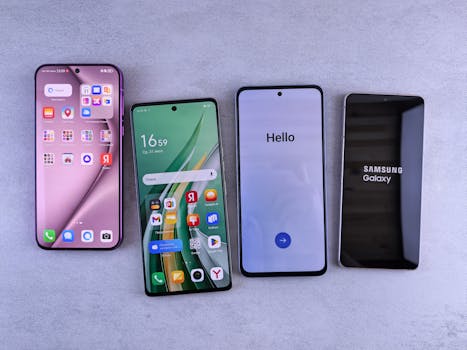 Photo: Andrey Matveev / Pexels
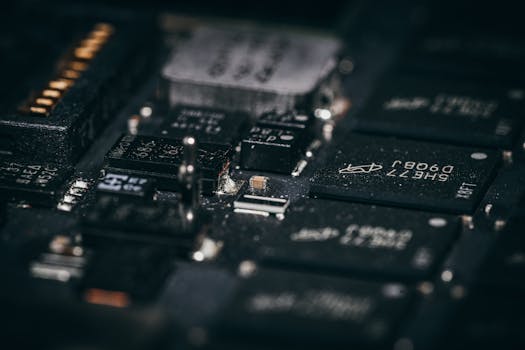 Photo: Jakub Pabis / Pexels
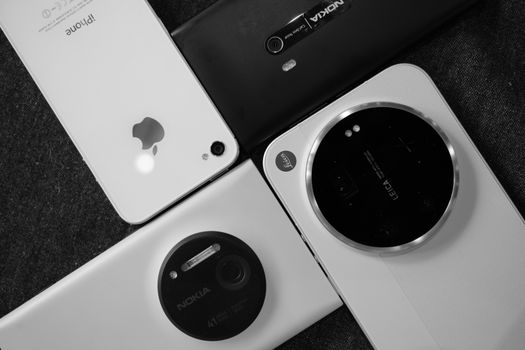 Photo: Phong Thanh / Pexels
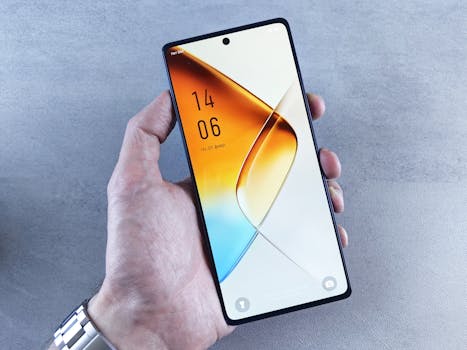 Photo: Andrey Matveev / Pexels